
Authors:
Vikrant Maheshwari, Rajinikanth Chimarla, Praveena Kakarla, Kip Kirkpatrick, William Krieski, Ambica Pasham, Brian Pritchard, Harish Ramanathan, Sridhar Vustikayala, Kam Yee
Abstract:
The invention provides a mechanism for improving the Self Check Out(SCO) experience by allowing customers to autonomously void or return scanned items without the need for store personnel intervention.
It reduces delays caused by bottlenecks in obtaining associate help and creates an automated item re-routing system that classifies returned goods by type, urgency, and condition for optimized restocking.
Background:
For stores like Costco or Walmart, there are typically six or more self-checkout kiosks monitored by only a single on-floor representative. Customers frequently run into issues such as:
- Scanning an item twice
- Discovering a price discrepancy
- Deciding to cancel an item
- Checking the price and changing their mind
In such cases, the checkout process enters a “Help” mode requiring intervention from the associate. This creates a queue where multiple kiosks may remain stuck, leading to long customer wait times as the on floor representative typically authenticate via barcode and PIN to assist and void items.
Additionally, many items that are picked up but not purchased are left in carts near the self-checkout area. These must be:
- Sorted by department
- Returned to the correct shelf
- Handled urgently if they are perishable (e.g., frozen food, medicine)
Due to limited staff availability, this process is inefficient, creates inventory management challenges, and impacts customer experience
Description:
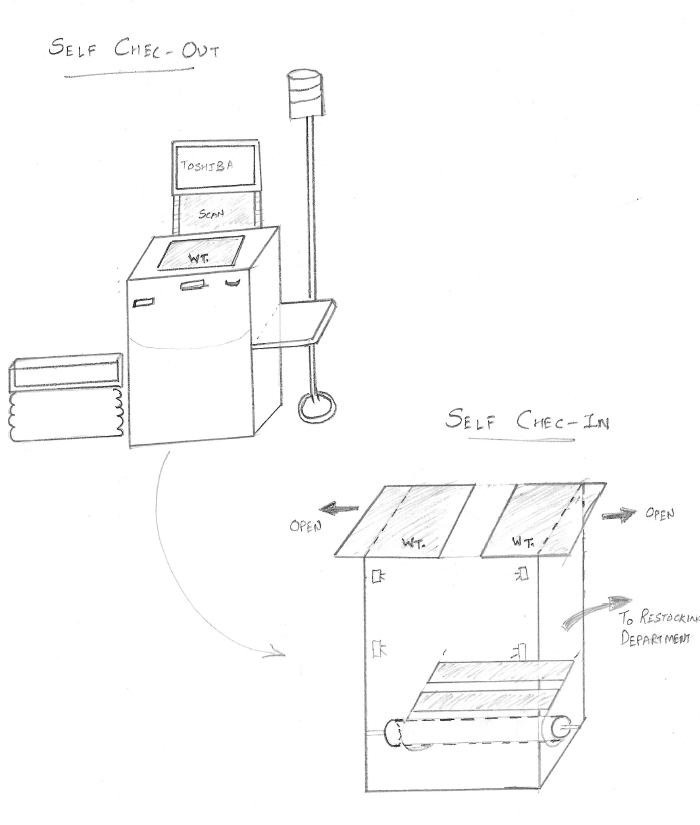
This invention introduces a Self Chec-In system that enables autonomous customer action for voiding items or returning them in a structured, AI-powered manner.
Key Features:
- Void Confirmation Prompt:
When a customer removes a scanned item from the scale, a kiosk pop-up appears:
“Do you want to void the item ‘XYZ’?”
- Determining Removed Items:
Detection can be achieved via:- Image/Video recognition tracking item motion from scale to hand
- Weight change probability matching
- Requesting the customer to rescan the item
- Rectangular Box Scale with Cameras:
A kiosk-mounted glass-covered scale box is used to:- Scan items from multiple angles using AI
- Validate packaging integrity
- Flag anomalies for manual intervention
- Automated Conveyor Rollers:
Below the scale is a conveyor system that routes voided/returned items based on:- Department mapping
- Time-sensitivity (e.g., frozen goods)
- High-demand signals (for front display restocking)
- Detected damage (for discount or removal)
- Self Chec-In as an Alternative Return Mechanism:
- Issue automatic refunds via kiosk
- Restock items without staff interaction
- Separate routing for perishables and regular items
- AI-based tagging of damaged goods with confidence scores and human verification
Benefits:
- Minimizes friction and delay in self-checkout lanes
- Reduces customer dependency on store associates
- Optimizes internal return and restocking logistics
- Improves inventory accuracy and customer satisfaction
Enabling Technology:
- AI/ML for object detection and classification
- Smart POS systems with integrated weight-based sensors
- Conveyor-based routing hardware
TGCS Reference 4431