Authors:
Amy Gray, Dan Kelaher, Lorraine DePolo, Jeff Thiessen
Abstract:
This Disclosure proposes a novel way for self-checkout kiosks to utilize AI and a leverage system to detect when a shopper might require additional stability support and enact an extended lever from the kiosk for additional balance and support.
Background:
People who have mobility issues or who use mobility-assisted items such as a walker, cane, or crutches face stability and balance issues with self-checkout kiosks. Those with mobility issues are faced with navigating several challenges at the self-checkout kiosk. The main problem is ensuring a safe and stable touchpoint for a shopper to bear weight and create a stabilized stance while maneuvering items and going through the checkout process. At current self-checkout kiosks, it is challenging for shoppers to hold on to their stability tool such as a cane or walker and go through self-checkout. A shopper with stability issues may have to rely on a shopping cart with wheels for a stability touchpoint that isn't the safest option.
There isn’t a formal known solution for this problem other than when shoppers need a stable touchpoint at self-checkout, they often put their hand and bear weight in the scanning area. This is not ideal for the machine and can throw off sensors or cameras. It is also not the safest stability touchpoint for the shopper as the scanning and kiosk area is not designed for that type of interaction and can be difficult to grip or does not allow enough room to scan and bear weight. To date, there is no solution that identifies when a shopper might need mobility assistance and then provide a safe and stable touchpoint option for them to bear their weight and smoothly proceed through self-checkout.
Description:
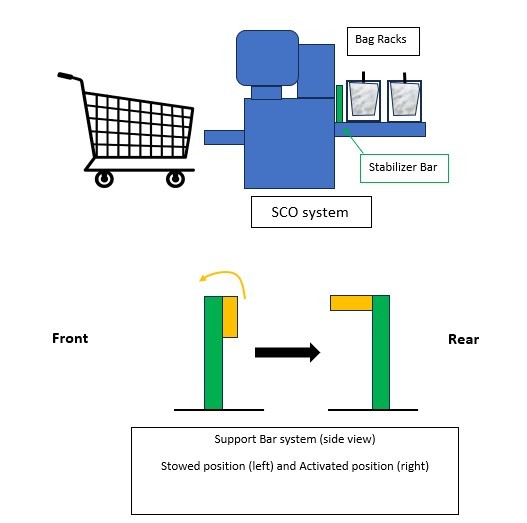
Our invention is a stability system that helps determine if a shopper might have mobility issues and then activates a stability lever that is stored within the self-checkout kiosk. The cameras in the self-checkout kiosk can use AI to identify if a shopper is using a mobility assistance device like a cane, walker, (motorized) wheelchair, or crutches as the shopper approaches the kiosk. AI or sensors in the cameras or scanning area of the kiosk can also detect if a person is keeping their hand and bearing down weight in the scanning area to hold on to for stability.
Once the system detects a person might need stability assistance either through AI cameras or by hand weight on the system, it can prompt a button on the touchscreen display if the shopper would like stability assistance and show a short and simple animation of the leverage system that will be activated. The person has the option to accept or decline the leverage system prompt. If they accept, a small pole will slowly pop out vertically from the edge of the kiosk near the scanning area and will be between the scanning area and the bagging area.
The pole will be about 8-10" tall (height adjusted according to how tall the kiosk is to align with standard elbow height for the shopper) and has a retractable horizontal hand grip lever that is about 6” long that has a small and slow spring release to prompt the shopper to pull the horizontal lever out and lock into place. The pole has a swivel option to adjust the direction of the horizontal hand grip lever. A short animation of the action can play at the bottom left of the touchscreen display to educate the shopper on how the system works. The shopper will be able to continue the checkout process while the animation is playing and not interfere or interrupt the checkout user experience.
With the pole and hand grip lever locked into place, this solves the problem by giving the shopper a stable and solid touchpoint at the self-checkout kiosk. The placement between the scanning area and bagging area allows a solid touchpoint from scanning and payment, to collecting bags. The shopper has more confidence in their stability and safety at self-checkout, will be less incumbered proceeding through self-checkout, and they can checkout without interfering with the cameras or the self-checkout technology.
There is also the option for a shopper to activate the stability system without needing a prompt for the machine. There can be a button next to where the pole comes out with an image for the stability system. The shopper can press the button and activate the pole to pop out of the kiosk.
To return the stability system into the kiosk, the shopper can press the same activate button from the kiosk to prompt the system to unlock the horizontal hand grip direction, close the horizontal hand grip to the original flushed position, and prompt the pole to retract back into the kiosk. Using AI, the system will be able to detect if a shopper forgot to prompt the stability system to retract and will start the retracting process after a certain timeframe, or when the next shopper comes up and AI detects they won’t need stability assistance.
See below:
TGCS Reference 00868