
Authors:
Brad Johnson, Kevin Xu
Abstract:
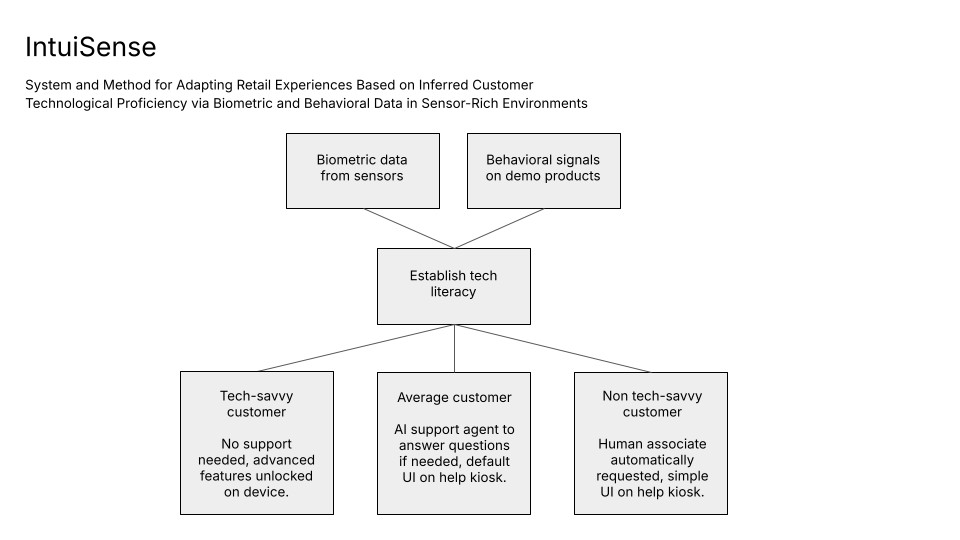
This disclosure proposes a system that combines physical biometrics from sensors (e.g., age estimation, gait analysis) and behavioral signals on demo products (e.g., interaction with tech interfaces, hesitation patterns, errors) to estimate tech literacy.
Tailored experiences and varying levels of support can then be provided, ranging from no support, basic AI agent, to expert/associate coming to you. This helps buyers make informed buying decisions. Tailored interfaces can include simpler UIs for low-tech-literacy customers, or advanced features for high-literacy customers. The system operates in embedded, sensor-laden retail contexts and pop-up stores or mobile kiosks.
Background:
Retail environments with technology as their core products lack ways to automatically gauge the technological proficiency of their customers. As the elderly digital divide widens, there are disconnects in retail between customers of varying tech-proficiency levels and help tailored just for them.
Description:
The IntuiSense system operates in a sensor-rich retail environment equipped with depth cameras, microphones, and pressure-sensitive flooring. Upon entry, the system captures biometric signals such as estimated age (via facial recognition and posture analysis), gait stability, and reaction time. These inputs are combined with behavioral data from product interaction zones—such as time taken to complete interface tasks, number of backtracks or errors, and gaze tracking during product exploration.
A scoring engine powered by a decision-tree classifier or Bayesian inference model estimates the customer’s tech literacy on a standardized scale. Based on this score, the system dynamically adjusts several experience layers: (1) the user interface complexity of digital kiosks or demo products (e.g., simplified navigation for low-literacy users), (2) the level of support offered, ranging from AI chatbot assistance to live associate intervention, and (3) the amount of informational content shown. The system continuously updates user classification throughout the session to refine engagement in real time. Privacy safeguards ensure all biometric data is ephemeral unless opted in. IntuiSense is compatible with fixed and mobile retail spaces such as kiosks, trade shows, and truck-based pop-ups.
The following figure demonstrates the idea:
TGCS Reference 00786