
Authors:
Ray Kirk, Jeff Thomas
Abstract:
This disclosure describes a special fastener that uses standard tools for assembly but once assembled cannot be removed without access to both sides of the assembly. This provides a method to attach access panels, fixtures, etc. between an insecure/public area and a secure/private area while maintaining the integrity of the secure/private area.
Background:
The requirement arises, in multiple situations as a means to attach access panels, fixtures, or other items such that it is difficult or impossible to remove these items to gain access to a secure area. This publication describes a special fastener that uses standard tools for assembly but once assembled cannot be removed without access to both sides of the assembly. This provides a method to attach access panels, fixtures, or other items between an insecure/public area and a secure/private area while maintaining the integrity of the secure/private area.
One-way or security fasteners exist that require special tools exist but have drawbacks. One-way fasteners do not allow disassembly without damage. Security fasteners that require special tools can be bypassed by either fabricating or procuring the tool. Other solutions require the item being attached to be specifically designed or modified such that no fasteners are accessible from the insecure/private area.
The proposed fastener can be used to attach standard or unmodified items with standard tools so that they cannot be removed from the insecure area but can be removed as required using standard tools with access to the secure area, An example where this fastener may be used is the attachment of a fixture to a door where removal from the outside would allow access to the inside (secure side) of the door. In this example it may be advantageous or even required that removal be possible for service or other reasons.
Description:
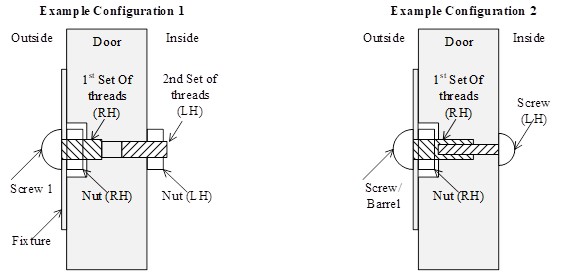
This invention makes use of a fastener with both left land (LH) and right hand (RH) threads so that once the assembly is complete it is not possible to dissemble without inside access since turning the fastener from the outside results in tightening the assembly with respect to one or the other set of threads. With inside access, the locking portion of the fastener can be removed allowing the assembly to be removed. The attached drawing shows 2 configurations for this fastener. Configuration 1 is a screw with 1st set of threads next to the head and a 2nd set of smaller diameter opposing threads on the far end. The fastener is attached to the fixture using a nut on the 1st set of threads and then the fixture is attached to the door using a nut on the 2nd set of threads. Configuration 2 is a barrel type fastener with 1st set of threads on the outside and a 2nd set of opposing threads on the inside. The fastener is attached to the fixture using a nut on the 1st set of threads and then the fixture is attached to the door by screwing into the 2nd set of threads. Where it is possible for the fixture to rotate without removal of the security fastener, 2 or more security fasteners are required so that the inside portion cannot be loosened by rotating the fixture. The configurations both show the 1st set of threads as RH and the 2nd as LH but these could be reversed and have the same effect.
TGCS Reference 1997