
Authors:
Logan Stanfield, Rhonda Foshee, Meredith Vaughan
Abstract:
The goal is to provide an enhanced scale to compute and display a more accurate estimate on nutritional information based on the weight of the specific produce item that is placed on the scale or the seafood item selected from a picklist
Background:
FDA nutrition labeling is required for most prepared foods; however, it is voluntary for raw produce items and fish. The FDA provides printable charts that can be placed near the relative produce items to show nutrition information to the customer. This chart assumes the weight of the produce item and provides the associating nutrition information based on that assumed data. This can be problematic for people that require a more accurate estimate of the nutritional value of the produce or seafood item they are attempting to purchase. The goal is to provide an enhanced scale to compute and display a more accurate estimate on nutritional information based on the weight of the specific produce item that is set on the scale or the seafood item selected from a picklist
Description:
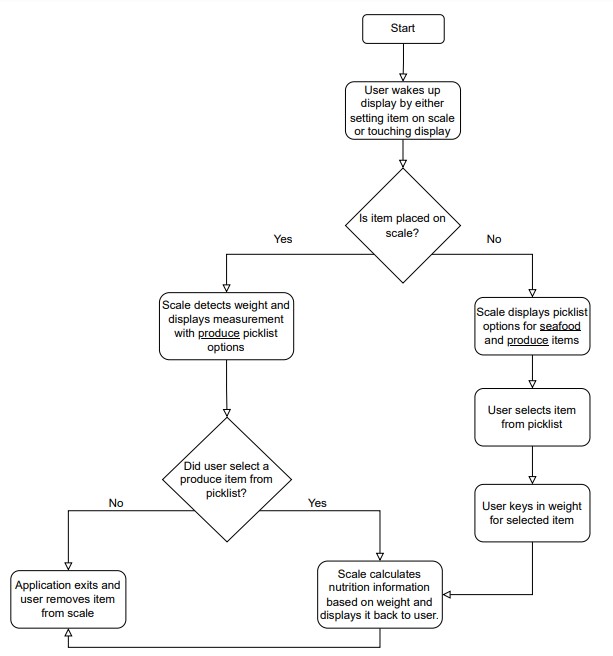
The way this invention works is to allow customers to receive estimated nutrition information by selecting the item type from a picklist after setting the item on the digital smart scale or by keying in the weight. Once the weight of the item is received, an estimate will be calculated based on the FDA provided nutrition values and that estimate will be displayed back to the customer. The smart scale can be activated by either setting an item on the scale or by touching the display. Because of the way seafood is packaged, obtaining the seafood nutritional estimate would require keying in the weight rather than setting the item directly on the scale.
In terms of implementation, the FDA information for each supported produce item would have to be broken down to the individual nutritional fact per weight (ounce/gram). That way the weight of the produce item on the scale could be multiplied by each broken down nutritional fact to receive a closer estimate with the actual item being calculated. For example, the FDA notes that an 8 ounce apple has roughly 130 calories, so this effectively means that an apple that has 16.25 calories per gram. If a customer was to set a 10 ounce apple on the scale, the calorie estimate would be 162.5 calories (16.25 * 10oz). This would be done with all the nutritional facts such as calories from fat, total fat, sodium, potassium, etc. Once the broken down FDA information is gathered, this data can be stored in a database such that it is accessible from the digital scale to calculate the estimate.
Links:
FDA Documentation: https://www.fda.gov/food/nutrition-food-labeling-and-critical-foods/nutrition-information-raw-fruits-vegetables-and-fish
Usages:
- In-store scales located often in the produce sections of common grocers.
- Scales used by Self-Checkout solutions.
Claims:
- Free-standing scales in produce sections
- Scales adopted by Self-Checkout
Enabling Technology:
A). Claims software written to collect and maintain produce and fish nutrition information.
B). Claims algorithm to calculate the current nutritional information for current produce or fish item.
TGCS Reference 3634